Every customer call is an opportunity to answer a question, schedule an appointment, qualify a lead, or build a stronger relationship. However, as businesses grow, managing every call quickly and consistently becomes increasingly difficult. Customers may experience long waiting times, missed calls outside business hours, or repeated requests for basic information.
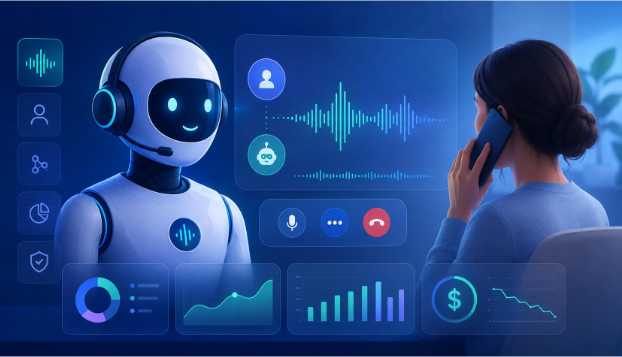
AI voice agents are changing how businesses manage these conversations. They let customers speak naturally with an AI-powered system that can understand requests, retrieve information, and perform approved actions through connected business applications.
Unlike traditional interactive voice response (IVR) systems that depend on fixed menus, modern AI voice agents support more flexible, context-aware conversations.
In this guide, we explore how AI voice agents work, their business applications, key benefits, and important considerations for implementing voice AI solutions.
1. What Is an AI Voice Agent?
An AI voice agent is software that communicates with people through spoken language. It combines speech processing, artificial intelligence, conversation management, and business-system integrations to understand requests and respond appropriately.
Depending on its configuration, an AI voice agent can answer common questions, qualify leads, schedule appointments, provide order updates, or route callers to the appropriate team.
For example, an AI appointment-booking agent can ask a customer about their requirements, check available time slots through a connected scheduling system, collect necessary details, and confirm a booking.
Unlike basic automated phone menus, AI voice agents can understand natural-language requests and ask follow-up questions when information is missing.
2. How Do AI Voice Agents Work?
A typical AI voice agent follows five stages:
Step 1: Incoming or Outgoing Calls
A customer communicates with the system through a phone line or supported voice channel. Depending on the application, the agent can handle incoming inquiries or authorized outbound calls.
Step 2: Speech Recognition
Speech recognition technology converts audio into text or processes it through a speech-capable AI model, allowing the system to understand the caller's request.
Step 3: AI Conversation Engine
The AI engine identifies the caller's intent, considers conversation context, and determines an appropriate response or next action. It can also ask clarifying questions when necessary.
Step 4: Business System Integration
The agent can interact with connected applications such as CRM platforms, calendars, booking systems, and order-management tools to perform approved actions.
Step 5: Spoken Response
The system responds using text-to-speech technology or a real-time speech model and continues the conversation until it completes the request or transfers it to a human representative.
Voice applications may use separate speech-to-text, language-model, and text-to-speech components or a real-time multimodal model. Architecture choices influence response speed, voice quality, interruption handling, and implementation costs.
3. Six Practical Business Uses of AI Voice Agents
AI voice automation can support different business operations by handling routine voice-based interactions.
1. AI Receptionists
AI receptionists can answer routine inquiries, collect caller details, provide approved business information, and route calls to the appropriate person or department. They can help businesses manage incoming calls when employees are unavailable.
2. Appointment Scheduling
AI voice agents can check calendar availability, collect booking information and schedule or update appointments through authorized integrations. This is particularly useful for businesses that receive frequent appointment requests.
3. Customer Support Automation
AI voice agents can answer common questions, retrieve customer information, provide order updates, and assist with basic troubleshooting. Complex issues can be transferred to human support representatives.
4. Lead Qualification
Businesses can use AI phone agents to ask qualification questions, capture customer requirements and summarize conversations. With appropriate permissions, the system can also update CRM records for sales follow-ups.
5. Logistics and Operations
Voice AI can help customers check delivery progress, retrieve shipment information, and report operational issues. Requests requiring investigation can be routed to the appropriate operations team.
6. Industry-Specific Assistance
Real estate, hospitality, retail, education, and other service businesses can use customized voice agents to manage industry-specific inquiries and routine workflows.
4. AI Voice Agents vs. Traditional IVR
Traditional interactive voice response (IVR) systems use fixed menus and keypad options to route customer calls. Although useful for predictable call flows, complicated menu structures can frustrate customers.
AI voice agents provide more flexible conversations by interpreting natural-language requests, asking follow-up questions and interacting with connected business applications.
Key differences include:
- Interaction: Traditional IVR relies on predefined menus, while AI voice agents understand spoken requests.
- Flexibility: IVR follows fixed workflows, whereas AI agents can handle more varied conversations.
- Business integrations: AI voice agents can perform approved actions through connected systems rather than simply routing calls.
- Complexity: AI agents require additional testing, monitoring and operational safeguards.
Some businesses can benefit from combining both approaches, retaining IVR for simple call routing while using AI voice agents for more complex interactions.
5. What Makes a Good AI Voice Agent?
A reliable AI voice agent needs more than a natural-sounding voice. Several capabilities influence the customer experience.
- Natural conversations: It should handle pauses, interruptions, clarifying questions, and different ways of expressing requests.
- Low response latency: Long pauses can make phone conversations feel unnatural. Speech processing, model selection, and integration design influence response speed.
- Reliable integrations: The agent should verify appointment availability, order status, and customer information rather than inventing details.
- Conversation context: It should retain relevant information during a call so customers don't have to repeat themselves.
- Human handoff: When the agent cannot help, it should transfer the caller with a useful summary of the conversation.
- Privacy and compliance: Businesses should consider call-recording notices, consent, personal-data handling, and applicable regional regulations.
6. Common AI Voice Agent Implementation Challenges
Voice AI applications operate in real-world environments where background noise, accents, unclear speech, network delays, and interruptions can affect performance.
Other challenges include maintaining conversation context, preventing incorrect system updates and ensuring reliable integrations with existing business applications.
Businesses should test realistic calls and monitor task completion rates, transfer rates, response latency and integration errors.
They should also define which actions an AI agent can perform independently and which require human confirmation. If the system cannot understand a request or verify information, it should offer an appropriate fallback instead of making assumptions.
7. How Businesses Can Implement AI Voice Agents
Successful implementation begins with identifying a specific business problem, such as managing reception calls, scheduling appointments, or answering routine customer inquiries.
Businesses should follow these steps:
- Define the use case: Identify which calls and customer interactions are suitable for automation.
- Map conversation workflows: Define common questions, expected responses, escalation rules, and permitted actions.
- Select AI technology: Choose suitable speech recognition, language models, and text-to-speech technologies.
- Integrate business applications: Connect calendars, CRM platforms, booking systems, or other required applications.
- Develop and test: Build the voice experience and test realistic scenarios, including interruptions and incomplete requests.
- Monitor performance: Evaluate response speed, task completion, customer experience, and system reliability.
A production-ready AI voice solution should also include appropriate privacy controls, human escalation, and continuous monitoring.
Frequently Asked Questions About AI Voice Agents
What is an AI voice agent used for?
AI voice agents handle routine customer inquiries, appointment scheduling, lead qualification, order updates, call routing, and voice-based business workflows.
How are AI voice agents different from IVR?
Traditional IVR systems primarily use fixed menus and keypad selections. AI voice agents can understand natural-language requests, maintain conversation context, and interact with connected business applications.
Can AI voice agents schedule appointments?
Yes. When integrated with an authorized calendar or booking system, they can check availability and create or update appointments according to defined permissions.
Can AI voice agents transfer calls to human employees?
Yes. A properly designed voice agent can identify when human assistance is needed and transfer the caller with relevant conversation context.
Conclusion: Improve Customer Conversations With AI Voice Agents
AI voice agents are creating new opportunities for businesses to manage customer conversations, automate routine tasks and connect phone interactions with everyday business workflows.
From AI receptionists and appointment scheduling to customer support and lead qualification, their effectiveness depends on reliable integrations, carefully designed conversations, and appropriate human oversight.
At Vision Vivante, we help businesses develop AI-powered applications, custom AI voice agents, conversational interfaces and integrations with existing business systems.
Whether you need an AI receptionist, an appointment-booking assistant or a voice-enabled customer support solution, our team can help turn your requirements into a practical AI-powered solution.